Bull's-Eyes and Misfires: 50 People Whose Obscure Efforts Shaped the American Civil War by Clint Johnson
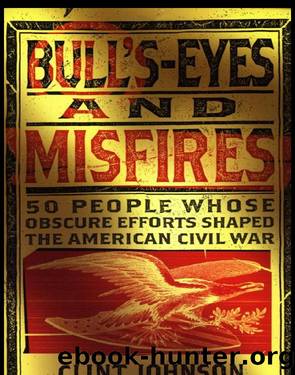
Author:Clint Johnson
Language: eng
Format: epub
Tags: ebook, book
Publisher: Thomas Nelson
Published: 2010-03-29T16:00:00+00:00
Gen. Joseph Reid Anderson
(1813-1892)
THE CONFEDERACY âS IRONMAKER
BULLâS-EYE
THE SOU TH HAD MANY MILITARY GENERALS LEADING soldiers on the battlefield. It had only one businessman general leading factory workers.
That was Gen. Joseph Reid Anderson.
Without the business acumen mixed with the engineering knowledge that Anderson possessed, the South never would have armored the CSS Virginia. It never would have armed that ironclad with the best cannon manufactured during the war. It never would have supplied Confederate forts and field artillery units with thousands of cannon. Without Anderson managing two thousand employees in the Southâs largest manufacturing operation, the industrial North would have quickly smashed the South.
While âbusiness senseâ might not normally seem to be a fighting quality, it was just what the South lacked, what it most needed, and what Anderson had. Although he allowed his ego to cause him to make one almost fatal misfire on the battlefield, and he was too bull-headed to modernize his factory when he had the chance in antebellum America, it was Andersonâs skills behind the desk that make his overall war career a bullâs-eye. Thanks to Anderson, the Southern army had cannon and the Southern navy had iron plating for its formidable ironclads.
Andersonâs ambition after graduating from West Point in 1836 was to quickly move into the private sector where he could make much more money. After barely a year in the U.S. Army, Anderson resigned to take a civilian job as engineer on the Valley Turnpike. Designing such a highway would be a feather in the cap of any young civil engineer, but Anderson wanted still more money. Within a few months he was eyeing employment with Tredegar Iron Works in Richmond.
In the late 1830s Tredegar was a small iron works manufacturing railroad rails. As that market was drying up, Tredegarâs owners were looking for someone to open up new markets when they discovered Anderson. What they saw in Anderson was what he saw in himselfâa bright young man who understood engineering and who had a driving ambition to make money. Anderson had the careful, analytical nature of an engineer combined with the marketing sense of a businessman. That was a rare combination of skills in a southern economy dominated by agriculture.
Anderson eagerly job-hopped again to become Tredegarâs chief commercial agent or salesman in March 1841. There he found his calling, staying at Tredegar for the next thirty-five years, first as employee, then as manager, then as owner.
Hitting the ground running, Anderson won contracts from the army to manufacture ammunition for existing cannon and contracts from the navy to manufacture cannon. Tredegarâs catalogs had never before contained cannon, but Anderson the salesman convinced his U.S. government buyers he could deliver.
The companyâs reputation grew in the 1850s as Anderson pursued government and private contracts in the North as well as in the South. At a time when most northern factories were segregated by race and even European origin, Anderson integrated his work force by hiring slaves from local owners.
In 1859, as war seemed inevitable between North and South, Anderson and U.
Download
This site does not store any files on its server. We only index and link to content provided by other sites. Please contact the content providers to delete copyright contents if any and email us, we'll remove relevant links or contents immediately.
The Vikings: Conquering England, France, and Ireland by Wernick Robert(84606)
Ali Pasha, Lion of Ioannina by Eugenia Russell & Eugenia Russell(40384)
The Conquerors (The Winning of America Series Book 3) by Eckert Allan W(39136)
The Vikings: Discoverers of a New World by Wernick Robert(37051)
Cecilia; Or, Memoirs of an Heiress — Volume 1 by Fanny Burney(32726)
Cecilia; Or, Memoirs of an Heiress — Volume 2 by Fanny Burney(32090)
Cecilia; Or, Memoirs of an Heiress — Volume 3 by Fanny Burney(32068)
Empire of the Sikhs by Patwant Singh(23207)
The Secret History by Donna Tartt(19476)
Hans Sturm: A Soldier's Odyssey on the Eastern Front by Gordon Williamson(18727)
Cat's cradle by Kurt Vonnegut(15559)
Pimp by Iceberg Slim(14805)
Sapiens: A Brief History of Humankind by Yuval Noah Harari(14558)
Norse Mythology by Gaiman Neil(13576)
Talking to Strangers by Malcolm Gladwell(13559)
Leonardo da Vinci by Walter Isaacson(13525)
4 3 2 1: A Novel by Paul Auster(12628)
Underground: A Human History of the Worlds Beneath Our Feet by Will Hunt(12237)
The Radium Girls by Kate Moore(12189)
